Pavillon Le Vau
Le Pavillon pédagogique Le Vau est un projet en bois et en terre crue, construit dans un groupe scolaire du 20e arrondissement de Paris. Le projet a nécessité de combiner trois enjeux : envisager une architecture capable de penser à la fois l’accueil et la pédagogie ; créer un lieu de jonction entre l’école et son quartier ; s’inscrire dans la décarbonation de la construction.

Ce projet est le fruit d’une part d’initiatives institutionnelles : programme OASIS et budget participatif de la Ville de Paris ; et d’autre part d’une observation de l’équipe enseignante de l’école Le Vau, qui relève de manière constante, une difficulté à convaincre les parents de passer les portes de l’école, d’y rester, de s’y sentir accueillis ou attendus. Elle observe une forme d’inhibition, voire de méfiance à l’égard de l’école comme institution.
Le programme OASIS cherche à végétaliser les cours d’école pour contribuer à la lutte contre les ilots de chaleur à l’échelle de la métropole. Le groupe scolaire Le Vau a bénéficié de ce programme et de nombreux espaces vacants ont été plantés dans les espaces extérieurs de l’enceinte scolaire, permettant de nouvelles activités grâce au potager, au verger et à l’espace pique-nique. Ces espaces et ces usages ont permis aux parents et aux enseignants de trouver de nouveaux lieux d’échanges et c’est de là qu’est née l’idée de réfléchir, dans le cadre du budget participatif, à la création dans la cour de l’école d’un espace d’accueil et de pédagogie.


Notre rôle d’architectes a donc consisté à mener une réflexion qui alliait des enjeux de nature différente : l’architecture capable de penser deux usages différents ; la jonction entre l’école et son quartier ; la décarbonation de la construction.
Et c’est avec la géométrie, que nous avons combiné ces trois enjeux et conçu cet espace inédit.
Nous avons choisi une salle circulaire (et non rectangulaire comme elles le sont traditionnellement à l’école), le cercle permettant des dispositions nombreuses, collectives, collaboratives et plus égalitaires entre chacun.


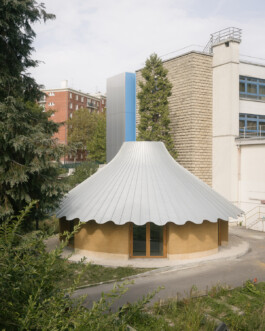
Il s’agit d’un bâtiment rond en pisé doublé d’une paroi en brique de terre crue et surmonté d’une charpente bois recouverte d’une toiture en zinc. A l’intérieur une bande servante périphérique et décentrée intègre des sanitaires et des rangements et est rythmé par six accès qui desservent six portes vitrée donnant sur l’extérieur. Le projet est construit en filière biosourcée et durable, dans une démarche écoresponsable. Il est le premier bâtiment porteur en pisé de Paris.


L’Atelier Senzu (Architecte Mandataire),
ThemaVerde (Environnement),
Sylva (structure bois), BGECO (économiste)
Voir également


Pavillon Le Vau
Le Pavillon pédagogique Le Vau est un projet en bois et en terre crue, construit dans un groupe scolaire du 20e arrondissement de Paris. Le projet a nécessité de combiner trois enjeux : envisager une architecture capable de penser à la fois l’accueil et la pédagogie ; créer un lieu de jonction entre l’école et son quartier ; s’inscrire dans la décarbonation de la construction.
Notre rôle d’architectes a donc consisté à mener une réflexion qui alliait des enjeux de nature différente : l’architecture capable de penser deux usages différents ; la jonction entre l’école et son quartier ; la décarbonation de la construction.
Et c’est avec la géométrie, que nous avons combiné ces trois enjeux et conçu cet espace inédit.
Nous avons choisi une salle circulaire (et non rectangulaire comme elles le sont traditionnellement à l’école), le cercle permettant des dispositions nombreuses, collectives, collaboratives et plus égalitaires entre chacun.
Il s’agit d’un bâtiment rond en pisé doublé d’une paroi en brique de terre crue et surmonté d’une charpente bois recouverte d’une toiture en zinc. A l’intérieur une bande servante périphérique et décentrée intègre des sanitaires et des rangements et est rythmé par six accès qui desservent six portes vitrée donnant sur l’extérieur. Le projet est construit en filière biosourcée et durable, dans une démarche écoresponsable. Il est le premier bâtiment porteur en pisé de Paris.
L’Atelier Senzu (Architecte Mandataire),
ThemaVerde (Environnement),
Sylva (structure bois), BGECO (économiste)
Voir également